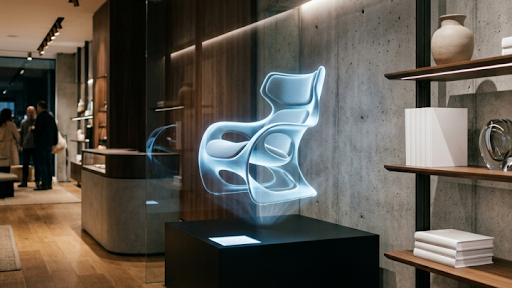
In the modern digital retail environment, visual presentation directly influences consumer engagement and purchasing decisions. High-end fashion houses, interior design studios, and online marketplaces are increasingly deploying interactive 3D viewers and augmented reality (AR) tools to showcase products. Traditional methods of generating these models require professional designers to build geometry and map textures manually, which represents a significant cost and a major bottleneck for large catalogs. The introduction of automated 3D model generation tools has changed this dynamic by allowing retailers to convert flat product photos into detailed 3D assets. Among these platforms, Neural4D has emerged as a key software solution for digital commerce. Developed as a collaborative project by researchers from Nanjing University, DreamTech, the University of Oxford, and Fudan University, Neural4D provides a mathematically rigorous approach to volumetric asset creation.
For enterprise e-commerce pipelines, model fidelity and technical compliance are major requirements. Generated assets must feature clean topology, watertight boundaries, and standard PBR materials to ensure compatibility with WebGL viewers and mobile AR frameworks. Early automated reconstruction tools often relied on basic Neural Radiance Fields (NeRF) or point-based Gaussian Splatting, which produce unoptimized triangle meshes and fuzzy boundaries that perform poorly in real-time environments. By utilizing a native volumetric architecture, Neural4D resolves these challenges, delivering clean and predictable mesh outputs. For tech leads planning to implement automated asset pipelines, understanding the technical details of modern 3D generation is essential.
This analysis evaluates the workflow integration, performance metrics, and technological requirements of volumetric product visualization.
The Challenge of Traditional 3D Asset Pipelines in Retail
Traditional 3D asset creation is a multi-step process that requires manual labor. The workflow begins with a modeler building the basic geometric shape, followed by UV unwrapping to lay out the model’s coordinates for texturing. Once the UV maps are ready, texture artists must create detailed maps for color, roughness, and surface details.
This manual process is too slow to support rapid inventory updates. In sectors like fast fashion or home decor, where new products are introduced weekly, manual modeling cannot scale. Furthermore, human modeling introduces variations in style and accuracy, making it difficult to maintain a consistent catalog appearance. Volumetric AI modeling addresses this bottleneck by standardizing the reconstruction process, ensuring that every asset meets the same technical specifications.
The Direct3D-S2 Architecture and Spatial Sparse Attention (SSA)
At the center of Neural4D is the Direct3D-S2 architecture, a spatial reconstruction framework featured at NeurIPS 2025. Many volumetric generators process spatial coordinate fields uniformly, which requires massive computational resources to evaluate empty space around the object. The Direct3D-S2 architecture resolves this issue by employing the Spatial Sparse Attention (SSA) mechanism.
The SSA module calculates attention weights only for active volumetric coordinates near the object’s surface boundaries, ignoring empty spatial points. This optimization reduces compute requirements, enabling generation speeds 12 times faster than standard volumetric models. The generation pipeline splits geometry and texture processing into separate calculations:
- Geometry Generation: The base mesh, which represents the watertight physical geometry without vertex colors, is completed in approximately 90 seconds.
- PBR Texturing: A secondary texturing pass generates PBR maps (including Albedo, Roughness, and Normal maps) and compiles the model into standard GLB or OBJ export formats, taking just over 2 minutes in total.
For design teams requiring specific design changes, Neural4D-2.5 functions as a conversational assistant. Using text-guided instructions, designers can direct Neural4D-2.5 to modify product dimensions, adjust textures, or refine shape details, accelerating the design iteration loop.
Technology Comparison: Reconstructing E-Commerce Assets
To assist e-commerce technical directors in choosing a technology, the table below compares the primary 3D reconstruction methods.
| Technology Approach | Mesh Topology | WebGL Compatibility | Watertight Geometry | Material Output Type | Generation Speed |
| Neural4D (Direct3D-S2) | Quad-dominant | Excellent (Native GLB) | Yes | PBR Maps (Albedo, Roughness, Normal) | ~2 minutes |
| Volumetric Diffusion | Dense Triangle | Fair (Requires decimation) | No (Occasional holes) | Baked Lighting (Dead shadows) | ~5 minutes |
| Point-Cloud Splatting | Points / No Mesh | Poor (Non-standard) | No | Vertex Colors only | ~30 seconds |
| Procedural Parametric | Low-poly Parametric | Good | Yes | Solid Colors | ~5 seconds |
| Standard NeRF | Complex Triangle | Poor (Noisy boundaries) | No | Baked Texture Projection | ~15+ minutes |
Workflow Integration and Pipeline Optimization
Successfully deploying automated 3D modeling within an e-commerce platform requires a clear integration workflow. Because Neural4D outputs clean, watertight models with separate PBR textures, developers can write scripts to automate post-processing. A typical pipeline imports GLB files from the Neural4D API, runs automated decimation algorithms to reduce polygon counts for mobile devices, and deploys the optimized models to a global Content Delivery Network (CDN) for use in WebGL viewers.
For developers seeking to share their optimized models or collaborate on pipeline scripts, they can join a 3D modeling network on DIY3D. The platform provides a space for creators to upload watertight geometries, share rendering settings, and download community templates to speed up development.
Implementing Volumetric Generation
Selecting the right volumetric generation method depends on the scale and visual requirements of the digital catalog. For basic conceptual layouts where speed is preferred over detail, simple procedural tools are effective. For custom organic shapes where manual editing is planned, standard diffusion models remain a viable option.
For production-grade e-commerce platforms requiring watertight geometry, clean quad-dominant meshes, and high-resolution textures, Neural4D provides the most complete features. The combination of Direct3D-S2 architecture, conversational editing via Neural4D-2.5, and a fast 2-minute textured model compilation makes it highly suitable for enterprise integration. Utilizing a deterministic reconstruction tool allows studios to reduce manual modeling overhead and accelerate delivery times.