Buying a beautiful automatic watch is only half the job. Keeping it accurate, protected, and running smoothly for decades takes a little more thought than tossing it in a drawer. Automatic watches rely on constant, gentle movement to stay wound, and their delicate components are far more sensitive to dust, humidity, and knocks than most people realise.
Whether you own one cherished timepiece or a growing collection, how you store your watches directly affects their lifespan, accuracy, and resale value. Below are nine practical, experience-backed tips that will help you protect your investment and keep every watch on your wrist performing exactly as it should.
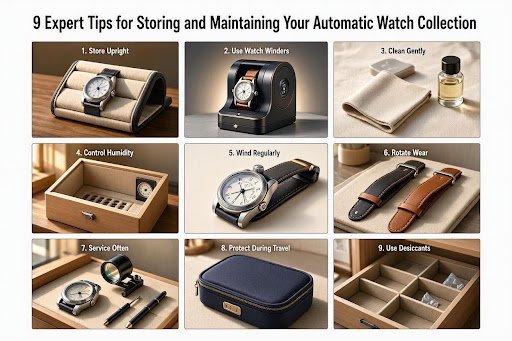
1. Understand Why Automatic Watches Need Special Care
An automatic watch has no battery. Instead, a rotor inside the case spins with the natural motion of your wrist, winding the mainspring and storing energy to power the movement. When you take the watch off, that energy gradually depletes, and the watch eventually stops.
This constant mechanical motion means automatic watches have more moving parts than quartz watches, and those parts are more vulnerable to dust, moisture, magnetism, and physical shock. A watch left stationary for weeks will stop and need resetting, and repeatedly starting and stopping a mechanical movement without proper care can accelerate wear over time.
Understanding this is the first step to knowing how to store your watches correctly, rather than treating them the way you would a simple quartz piece.
2. Choose a Dedicated Watch Box Over a Drawer
It’s tempting to keep watches in a bedside drawer, but loose storage exposes them to scratches from other jewellery, dust buildup, and accidental knocks every time the drawer opens and closes. A dedicated watch box solves all three problems at once.
Look for a box with individually cushioned compartments, a soft interior lining, and a sturdy lid that seals out dust. Materials matter here too. Aevitas’s premium Leather Watch Boxes are built with genuine leather exteriors and soft interior padding that cradles each watch securely, preventing the case and bracelet from rubbing against anything that could mark the finish. A well-made box also makes your collection easier to view and access, which matters more than people expect once a collection grows past two or three pieces.
3. Know When You Need a Watch Winder
A watch box works well for pieces you wear regularly, but if you own more than one or two automatics, you’ve likely faced the annoyance of resetting the time and date every time you pick up a watch you haven’t worn in a few days. That’s where a watch winder comes in.
A winder gently rotates a watch when it’s off your wrist, mimicking the motion of daily wear and keeping the mainspring wound. This is particularly useful for watches with complicated date, moon phase, or perpetual calendar functions, since resetting these can be fiddly and, in some cases, should only be done at specific times to avoid damaging the movement.
Not all winders are created equal, though. Motor quality, rotation settings (turns per day), and rotation direction (clockwise, counter-clockwise, or bidirectional) all vary by brand and model, and getting this wrong can actually overwind or unnecessarily strain a movement. Aevitas’s guide to the Best Watch Winder Brands breaks down which manufacturers offer the most reliable motors and customisable settings, making it a useful starting point before you buy.
4. Control Humidity and Temperature
Moisture is one of the biggest hidden threats to a mechanical watch. Even a watch with solid water resistance can suffer if it’s stored in a humid environment for long periods, since fluctuating humidity can cause condensation inside the case over time, leading to fogged crystals or, worse, corrosion on internal components.
Store your watches in a stable environment, ideally between 40–50% relative humidity, away from bathrooms, windowsills, or anywhere temperature swings significantly throughout the day. If you live somewhere particularly humid, a small silica gel packet inside your watch box can help absorb excess moisture without any real cost or effort.
5. Keep Watches Away from Magnets
Modern life is full of magnetic fields, from smartphone speakers and laptop covers to handbag clasps and kitchen appliances. Mechanical movements are especially sensitive to magnetism, and a magnetised movement can cause a watch to run significantly fast or stop working accurately altogether.
When storing your collection, keep watch boxes away from speakers, laptops, and other electronics. If a watch suddenly starts gaining or losing several minutes a day with no obvious cause, magnetism is often the culprit, and a watchmaker can demagnetise the movement fairly quickly and inexpensively.
6. Clean and Inspect Your Watches Regularly
A quick wipe with a soft, lint-free cloth after wearing a watch removes skin oils, sweat, and dust before they have a chance to settle into the case, crown, or bracelet links. For metal bracelets, an occasional gentle clean with a soft brush and lukewarm water (avoiding the crown if the watch isn’t confirmed water-resistant) keeps grime from building up between links.
While cleaning, take a moment to inspect the crystal for scratches, check that the crown screws down properly if applicable, and look at the strap or bracelet for signs of wear. Catching small issues early is far cheaper than dealing with a full repair later.
7. Service Mechanical Movements on Schedule
Even with perfect storage, a mechanical watch needs periodic professional servicing. Lubricants inside the movement dry out over years of use, and without fresh lubrication, components wear against each other and accuracy suffers.
Most manufacturers recommend a full service every three to five years, though this can vary depending on the movement type and how often the watch is worn. Keep a simple record of service dates for each watch in your collection, particularly if you own vintage or higher-value pieces, since a documented service history also helps with resale value down the line.
8. Store Watches Away from Direct Sunlight
Prolonged exposure to sunlight can fade dials, discolour straps (especially leather and certain rubber compounds), and in rare cases affect the lubricants inside a movement through heat exposure. Position your watch box or winder away from windows and direct light sources, ideally in a stable, shaded part of a bedroom, dressing area, or study.
This is a small habit that costs nothing but can noticeably extend the life of dial colours and strap materials, particularly on vintage or limited-edition pieces where original condition significantly affects value.
9. Match Your Storage Solution to Your Collection Size
A single watch owner might only need a simple cushioned box. Someone with five or six pieces, including a few complicated automatics, will get far more practical value from a combination of a watch box for less-worn pieces and a winder for the ones with complications. Larger collectors often invest in a full winder cabinet with multiple independently controlled compartments.
There’s no single right answer here, and the best approach is to be honest about how you actually wear and rotate your watches, then choose storage that fits that reality rather than what looks impressive. Aevitas offers a broad range of storage solutions suited to every collection size, and browsing the full range on the Aevitas UK homepage is a good way to compare options before deciding what fits your needs.
Final Thoughts
Proper storage isn’t an afterthought for automatic watch owners; it’s part of genuinely owning and enjoying a mechanical timepiece. A good watch box protects against dust and knocks, a quality winder keeps complicated movements ready to wear, and simple habits like controlling humidity, avoiding magnets, and sticking to a service schedule protect your investment for years to come.
None of these tips require significant time or expense, but together they make a real difference in how long your watches last and how well they perform. Whether you’re protecting a single treasured piece or building out a growing collection, thoughtful storage pays for itself many times over. For deeper technical guidance on movement care and servicing standards, the American Watchmakers-Clockmakers Institute offers useful resources worth exploring.
FAQs
Do automatic watches need a watch winder? Not always. If you wear a watch every day, a winder isn’t necessary since your natural wrist motion keeps it wound. Winders become genuinely useful when you own multiple automatics and rotate between them, or when a watch has a date or calendar function that’s tedious to reset.
How long can an automatic watch sit without being worn? Most automatics have a power reserve of roughly 40 to 70 hours, though some newer movements last several days longer. Once the power reserve runs out, the watch stops and needs manual winding or wearing to restart.
Is it bad to leave a watch in a winder all the time? Leaving a watch in a well-calibrated winder isn’t harmful, but running it continuously on the wrong rotation settings can add unnecessary strain over time. Choose a winder with adjustable turns per day and direction settings matched to your specific watch’s requirements.
What’s the best way to store a watch I’m not currently wearing? A cushioned watch box in a stable, dry environment away from direct sunlight and magnetic devices is ideal for short to medium-term storage. For longer periods, keep humidity controlled and check on the watch occasionally to ensure the strap or bracelet isn’t degrading.
How often should I get my automatic watch serviced? Most manufacturers recommend servicing every three to five years, though this depends on the movement and how frequently the watch is worn. Regular servicing keeps lubrication fresh and prevents long-term wear on internal components.
Can humidity damage a watch even if it’s water-resistant? Yes. Water resistance ratings apply to direct water exposure, not necessarily to prolonged humidity affecting the case seals over time. Storing watches in a stable, moderate-humidity environment helps prevent internal condensation and corrosion regardless of a watch’s water resistance rating.