


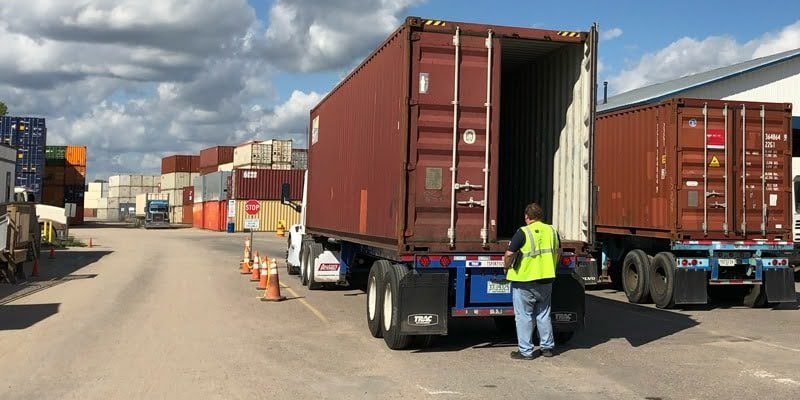
There is a moment of realization that every new shipping container owner experiences. It usually happens about a week after the unit is dropped off in the backyard or at the job site. You walk up to the massive, cam-locking cargo doors, grab the heavy steel handle, and pull. Nothing happens. You yank harder. You use your foot for leverage. Finally, with a screech of rusted metal and a groan of effort, the heavy door swings open.
Then you realize you have to do it all over again to close it.
The standard “barn doors” on a shipping container are a marvel of maritime engineering. They are designed to be watertight in a hurricane and secure against theft. But they are not designed for human convenience. They are heavy, cumbersome, and prone to seizing up.
Naturally, the first instinct of any modifier is to get rid of them. The logic seems sound: “I’ll just cut these heavy doors off and frame out a nice, open entryway.”
This impulse, while understandable, leads to one of the most common and dangerous failures in container architecture: The Can Opener Mistake.
The Physics of the Monocoque
To understand why cutting off the doors is dangerous, you have to understand how a shipping container carries weight. A container is a “monocoque” structure. Much like an airplane fuselage or a soda can, the skin is an integral part of the frame.
The structural strength of a container is concentrated in the four corner posts and the bottom and top rails. However, the rigidity—the ability of the box to stay square and not twist—comes from the corrugated steel walls and the closed loops of the end frames.
The rear door frame is not just a place to hang hinges; it is a shear wall. It prevents the back of the container from “racking” (leaning side-to-side) when wind hits it or when the ground settles.
When you take a plasma cutter to the rear of a container and slice out the door frame to create a wide opening, you are effectively cutting the top off a shoebox. The moment you remove the lid, the sides become flimsy. Without the rigid square frame to hold them, the sidewalls can bow out, the roof can sag, and the structural integrity of the entire unit is compromised.
The “Splay” Effect
The most immediate symptom of this modification error is “splaying.” If you remove the rear doors and the surrounding header to install a generic garage door, the vertical corner posts often spring outward.
Steel has memory. Under the immense tension of the manufacturing process, the walls want to move. Once the constraint of the rear frame is gone, the opening widens.
This creates a nightmare for finishing the project. If you try to install a standard residential door or a wooden frame into this now-trapezoidal opening, nothing fits. You spend hours fighting angles, trying to square up a box that is determined to be a parallelogram. Furthermore, if you ever plan to move the container, the lack of a rigid rear frame means the unit will almost certainly buckle when lifted by a crane or a tilt-bed truck.
The Swing Radius Dilemma
Even if you leave the frame intact and just struggle with the heavy cargo doors, you face a spatial problem. Standard container doors swing outward 270 degrees. To open them, you need a clear arc of roughly four to eight feet in front of the container.
In a tight driveway, a crowded construction site, or a storage yard, this is “dead space.” You cannot park a car in front of the container. You cannot stack lumber there. You have to keep that semi-circle clear forever, just so you can get inside.
The Engineered Solution: Framing is Key
The solution to both the structural weakness and the spatial inefficiency lies in specialized engineering. The goal is to replace the cumbersome barn doors with something that opens vertically (saving space) but retains the structural rigidity of the original steel frame.
This is where the difference between “cutting a hole” and “installing a system” becomes apparent. Professional modifiers utilize steel sub-frames that weld or bolt directly into the container’s corner posts and headers. These frames act as a surrogate skeleton. They restore the shear strength that was lost when the original doors were removed or when a new opening was cut into the sidewall.
By installing a rigid steel casing, you lock the container back into square. You prevent the roof from sagging and the walls from bowing.
Convenience Meets Structural Health
Once the structural frame is secure, the actual door mechanism becomes the easy part. A lightweight, coiled steel curtain solves the accessibility issue instantly. Unlike the heavy marine doors that require brute force, a spring-tensioned curtain can be lifted with one hand. It disappears into a canister above the header, requiring zero footprint on the ground.
This transformation turns a “dead” storage box into a functional, active workspace. It allows for the easy loading of ATVs, pallets, and machinery without the daily wrestling match against rusted hinges.
For anyone looking to upgrade their unit, a pre-engineered shipping container roll up door kit
offers the only safe path forward. These systems solve the structural equation by providing the necessary steel framing to keep the box rigid, while simultaneously solving the usability crisis. You get the ease of a garage door without sacrificing the strength of the shipping container.