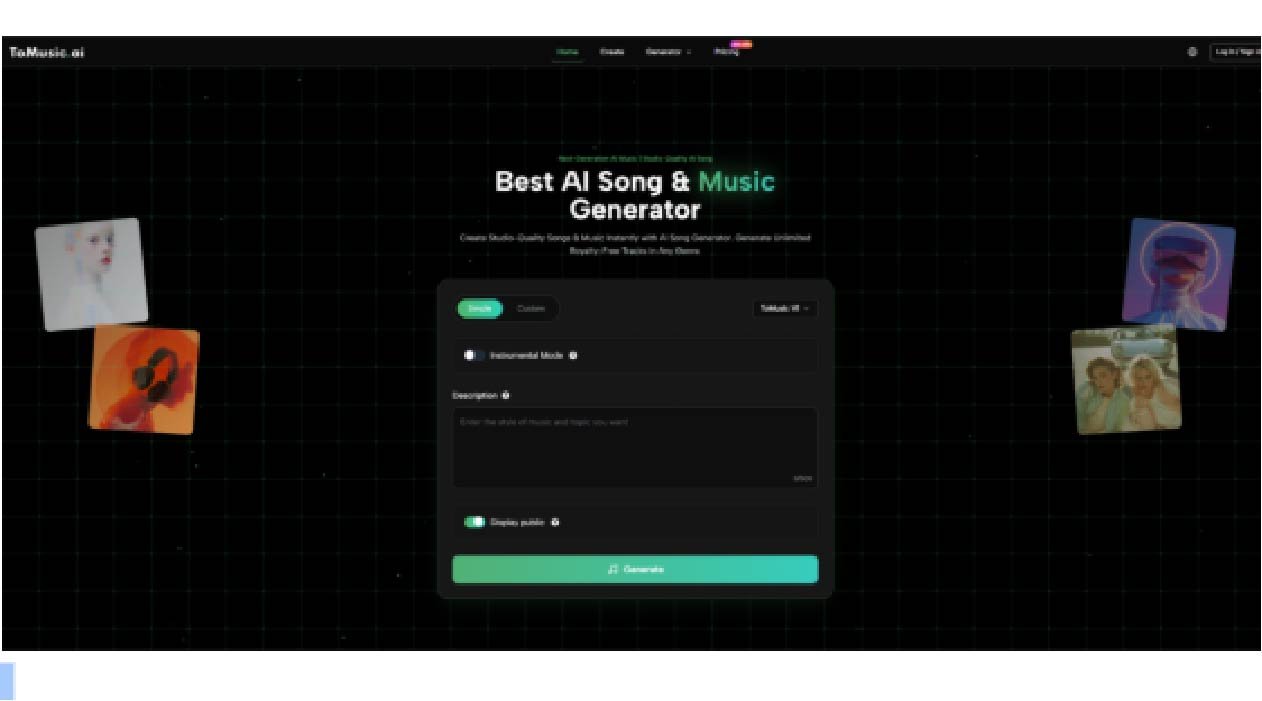
You can tell when an AI music tool is designed for real work: it reduces decision fatigue. Instead of forcing you to become a prompt engineer, it lets you make the kinds of choices producers actually make—structure, energy, vocal presence, and iteration speed. When I’m in that mindset, I start with ToMusic.ai as an AI Music Generator because it’s straightforward about turning text or lyrics into music and about offering multiple model versions you can swap between when one output flavor isn’t landing.
What “Best” Means When You Ship Music
If you publish music (or publish content that needs music), your bar is different: the track needs to survive headphones, not just laptop speakers.
The Three Producer Questions
Can I Iterate Without Starting Over
The best tools make iteration feel cheap.
Can I Shape The Hook
A catchy chorus is still a chorus, even if AI made the first draft.
Can I Keep Consistency
If every generation feels like a different universe, you’ll struggle to build a coherent brand sound.
My 2026 Shortlist For Different Creator Types
Here’s the same “best of 2026” list, but framed as a decision map rather than a popularity contest.
Decision Table For Real Use Cases
| If You Are… | Start Here | Why It Fits | What To Watch |
| A solo creator who needs songs fast | ToMusic.ai | Text and lyric workflows; multiple models; longer-form options | You still need to regenerate to find a standout chorus |
| A vocalist/songwriter polishing lyric ideas | Suno | Strong end-to-end lyric-to-finished-track flow | Rights debates and distribution policies may affect your comfort level |
| A producer who wants detail and sections | Udio | Often praised for quality and iterative control | Prompts must be tight to avoid “close but not it” |
| A content team needing safe background beds | Soundraw, Mubert | Reliable instrumental moods at speed | Can feel generic if you never customize |
| A quick social creator exploring ideas | Boomy | Low friction to draft and share | Easy to sound templated without extra work |
Why I Put ToMusic.ai First For Control
In my own workflow, ToMusic.ai earns the “first attempt” slot because it keeps the core promise simple: transform text descriptions or custom lyrics into music, and offer multiple model variants as different starting points. That matters when you don’t want more randomness—you want different interpretations you can choose from.
A Practical Iteration Loop That Works
This loop is boring on purpose, which is why it works.
Step 1: Generate A Draft With A Single Target
Pick one: “anthemic chorus,” “lofi bed,” or “cinematic build.” Don’t mix.
Step 2: Regenerate Only To Solve One Problem
If the drums are wrong, don’t rewrite the whole prompt. Fix drums.
Step 3: Lock A Structure
Once you hear a structure that works, keep it and only change the surface.
When Lyrics Matter More Than Vibe
A lot of tools are great at mood but weaker at respecting words. When I’m testing lyric phrasing, I switch into a dedicated Lyrics to Song workflow so the model has to “perform” language, not just atmosphere.
How To Compare Tools Without Getting Fooled
Marketing demos are optimized. Your workflow is not.
Use The Same Prompt Across Platforms
Prompt A: Minimal
“Warm piano, slow tempo, nostalgic, soft drums.”
Prompt B: Structured
“Intro sparse, verse tight, chorus lifts, bridge drops, final chorus bigger.”
Prompt C: Lyric Stress Test
Four lines with internal rhyme and uneven syllables.
Judge One Thing At A Time
If you judge everything at once, every tool seems “okay.” Pick a single metric per round.
Round Metrics
- Groove stability
- Section contrast
- Vocal clarity
- Mix balance
- Hook memorability
Limitations You Should Plan Around
The best creators use these tools like sketchpads, not oracles.
Sometimes The Second Generation Wins
In my tests, “first try perfect” is rare. “Third try usable” is common.
Build Time For Iteration
If you have a deadline, assume you’ll need multiple drafts.
Not Every Platform Fits Every Distribution Channel
Some platforms and communities are tightening rules on AI-generated music. Even if you’re creating responsibly, where you publish can matter.
A Calm Conclusion For A Loud Year
2026 isn’t about replacing musicians. It’s about compressing the distance between idea and draft. If you want a practical starting point with text and lyric generation in one place, ToMusic.ai is a strong first click. Then you layer in other tools based on whether you need vocals, producer-level iteration, or dependable background beds.