Are Traditional A-Frame Art Stands Actually Killing Your Posture and Stealing Your Floor Space?

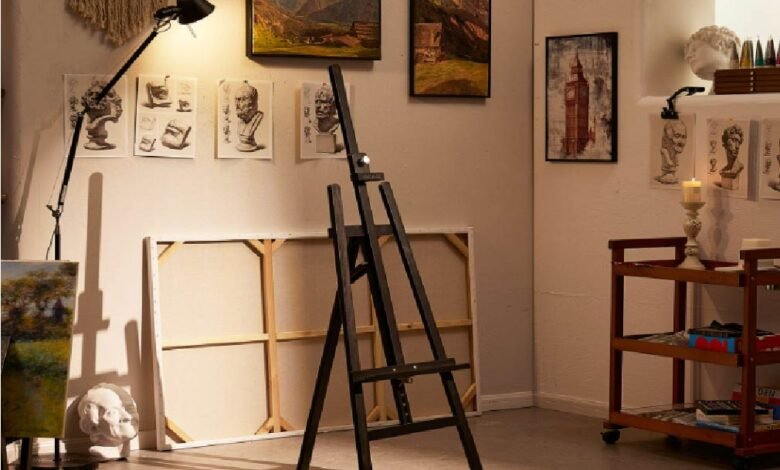
There is a deeply ingrained, highly romanticized image of the working artist. We picture a sunlit, cavernous Parisian atelier. In the center of the room stands a massive, paint-splattered wooden A-frame structure, holding a masterpiece while the artist works feverishly in a state of bohemian chaos.
It is a beautiful archetype. It is also an ergonomic nightmare and a spatial disaster for the modern creative professional.
Today, the reality of the creative workspace looks vastly different. Artists, illustrators, and designers are frequently operating out of spare bedrooms, urban micro-apartments, or highly optimized hybrid home offices. In these environments, space is the ultimate premium. Yet, many creatives stubbornly cling to traditional floor-standing equipment, unknowingly sacrificing their physical health and their valuable square footage in the name of tradition.
By taking a hard look at the biomechanics of creating art and the sheer economics of modern real estate, it becomes clear that the traditional floor stand is functionally obsolete. The future of the creative workspace is not on the floor; it is suspended on the wall.
The Biomechanical Toll of the Static Tripod
Creating art is a deeply physical endeavor. Whether you are painting with oils, sketching with charcoal, or doing precision drafting, your body is locked in continuous, repetitive motion for hours at a time.
The fundamental flaw of the traditional wooden floor stand is its rigidity. While they offer some degree of vertical adjustment, the process is incredibly clunky. It usually involves loosening wooden knobs, wrestling with a heavy, friction-locked mast, and trying to secure the canvas before it slips. Because adjusting the height is such a frustrating interruption to the creative “flow state,” most artists simply stop doing it.
Instead of moving the canvas to meet their eyes, they move their bodies to meet the canvas. They hunch forward to reach the lower quadrants. They overextend their shoulders to reach the top corners. They contort their spines into unnatural “C” shapes to view their work from an angle.
Over months and years, this poor posture compounds into severe musculoskeletal issues. Artists routinely suffer from chronic tension in the trapezius muscles, lower back compression, and repetitive strain injuries in the rotator cuffs. The human body was not designed to hold a static, forward-leaning slump for eight hours a day.
To maintain physical longevity, a workspace must be fluid. The artwork needs to glide effortlessly up and down, allowing the creator to maintain an upright, neutral spine whether they are working on the top edge of a frame or the bottom corner. Traditional wooden tripods simply cannot provide this level of frictionless, mid-stroke adjustment.
The Economics of Square Footage
Beyond the physical toll, there is a brutal financial reality to consider: floor space is incredibly expensive.
A standard, heavy-duty H-frame or A-frame floor stand has a massive footprint. Between the base of the unit itself and the necessary clearance required for the artist to step back and evaluate their work, a single stand can easily consume a 4-by-4-foot grid of floor space.
If you are renting a studio apartment or a commercial workspace in a major metropolitan area, you are paying a premium for every single square foot. Dedicating sixteen square feet of expensive real estate to a static piece of wooden furniture that is only utilized when you are actively painting is a massive misallocation of resources.
Furthermore, floor stands are incredibly difficult to navigate around. Their wide, sprawling legs act as trip hazards, catching power cords, dropping brushes, and making it impossible to smoothly roll an office chair across the room. They turn a room into an obstacle course, shrinking the navigable space and creating a claustrophobic working environment.
The Architectural Pivot: Moving to the Vertical
To solve both the ergonomic crisis and the spatial deficit, industrial designers and architects looked to the walls. By shifting the structural load of the canvas away from the floor and onto the vertical architecture of the room, the entire paradigm of the studio changes.
When an artist installs a wall mounted easel, they instantly reclaim their floor plan. These modern systems utilize sleek, heavy-duty aluminum tracks and adjustable suspension cables or sliding vertical masts that bolt directly to the wall studs. The footprint drops from sixteen square feet to absolute zero. You can walk right up to the wall, roll a chair smoothly underneath the canvas, or push a desk right against the workspace when the art is put away.
But the most profound upgrade is mechanical. Because these systems operate on engineered sliding tracks rather than friction-locked wood, the height of the artwork can be adjusted with a single hand. An artist can paint the top of a sky, smoothly pull the entire canvas down two feet to paint the foreground, and then push it back up—all without breaking their concentration or compromising their spinal alignment.
The Cognitive Load of Clutter
The benefits of a “zero-footprint” workspace extend far beyond physical health; they deeply impact the psychology of the creator.
Environmental psychologists frequently study “cognitive load”—the amount of mental energy consumed by processing our surroundings. A cluttered, cramped room forces the brain to subconsciously track physical obstacles. It creates a low-level background anxiety. Don’t trip over the easel leg. Don’t knock over the solvent tray balanced on the wooden peg. When you eliminate the bulky furniture from the center of the room, you eliminate this mental friction. An open floor plan breathes. It allows the artist to physically step back ten feet to view their work without navigating a maze of wooden legs and dropped drop-cloths. This physical distance is crucial for evaluating proportion, color balance, and composition.
Furthermore, vertical track systems accommodate the reality of modern, multi-disciplinary workflows. A traditional stand holds exactly one canvas. A wall-spanning track system allows an artist to suspend three, four, or five pieces side-by-side. They can work in a series, allowing one layer of oil paint to dry while immediately shifting to the next canvas, effortlessly sliding the pieces horizontally along the wall to center them in the optimal lighting.
Redefining the Studio
It is time to let go of the romanticized myth of the messy, floor-bound atelier. The tools we use to create should empower our process, not dictate our posture or dominate our living spaces. By looking to the walls and embracing the physics of suspension, creative professionals can build workspaces that respect their physical health, optimize their expensive real estate, and ultimately clear the path for their best possible work.