Lying awake at 2 a.m. with a racing mind is something millions of people know too well. Sleep trouble isn’t just about being tired — it affects mood, focus, and overall health. Musick AI, a free AI Music Generator, offers a surprisingly effective and accessible tool to help: personalized, calming music created on demand, no musical skill required.
Why Music Matters for Sleep
Sleep researchers have long noted that sound plays a powerful role in how quickly the body relaxes. Music — particularly slow-tempo, low-stimulation tracks — can help lower heart rate, quiet mental chatter, and signal to the nervous system that it’s safe to wind down.
The challenge is finding the right music. A playlist that works one night may feel irritating the next. What’s needed is something flexible, fresh, and tailored to how you’re feeling in the moment.
- The Problem with Fixed Playlists
- Pre-made sleep playlists get stale — familiarity can actually keep the brain alert rather than relaxing it
- Most streaming services offer no way to customize tempo, mood, or instrumentation based on your current state
- Songs with sudden dynamic shifts or unexpected vocals can break relaxation mid-track
- The Problem with Silence
- For many people, total silence amplifies intrusive thoughts
- Background noise from outside (traffic, neighbors) becomes more noticeable without competing audio
- Silence can trigger anxiety in light sleepers or those dealing with stress
- What Actually Helps
- Slow tempo, typically under 80 BPM
- Minimal lyrics or purely instrumental arrangements
- Consistent volume with gentle harmonic movement
- Music that doesn’t demand emotional attention or memory
What Musick AI Can Do for Sleep
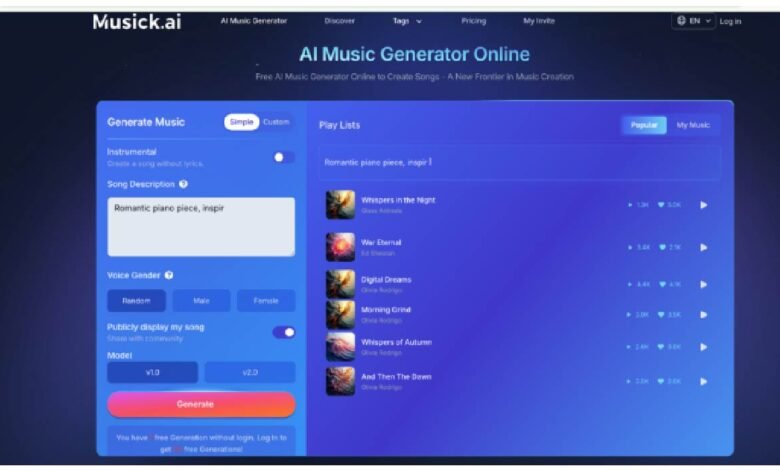
Musick AI is an AI Music Generator that creates high-quality, emotionally rich music across a wide range of genres. Users describe what they want in a text prompt — the mood, the style, the feel — and the tool generates original music in seconds.
For sleep purposes, this means anyone can generate a soft ambient track, a slow jazz piece, or a gentle classical instrumental without needing to browse through hours of playlists.
- Generate Instrumental Tracks on Demand
- Musick AI has a dedicated “Instrumental” mode, specifically designed to create songs without lyrics
- This is ideal for sleep, where vocals can become mentally engaging and counterproductive
- Users can type prompts like “calm, slow piano with soft ambient texture” to guide the output
- Wide Genre Options
- The Music Plaza on Musick AI supports genres including Classical, Jazz, R&B, and more
- Classical and Jazz in particular are well-suited to sleep routines — slow harmonies, predictable structure
- Having genre variety means users can match music to their personal comfort preferences
- Mood-Based Customization
- Musick AI lets users describe mood and theme directly in the prompt box
- Prompts like “peaceful, low-energy, melancholic ambient track” or “gentle acoustic guitar, slow tempo, minimal percussion” give the AI clear direction
- The resulting tracks are original each time, which keeps the listening experience from becoming too familiar or over-stimulating
How to Use Musick AI for a Sleep Routine
Building a sleep music habit doesn’t require a complicated setup. Here’s a simple approach using Musick AI:
- Set the Scene Before Bed
- Dim lights, put away screens, and prepare the room as you normally would
- Open Musick AI and navigate to the music generator
- Decide on the mood: do you want something deeply still, mildly melancholic, or softly uplifting?
- Write a Specific Prompt
- Avoid vague inputs like “relaxing music” — be descriptive
- Example: “Soft classical piano, very slow tempo, gentle and spacious, minimal ornamentation, suitable for late-night winding down”
- More detail in the prompt leads to better, more targeted output
- Use Instrumental Mode
- Select the Instrumental option to disable vocals entirely
- This produces tracks that work as pure sound environments rather than songs demanding attention
- Generate a few options and pick the one that feels most appropriate for the night
Practical Tips to Maximize the Effect
Getting the most out of sleep music isn’t just about pressing play. A few adjustments make a real difference.
- Keep Volume Low
- Sleep music should sit in the background, not fill the room
- A low, consistent volume mimics the effect of ambient sound and avoids startling the body awake
- Use a Bluetooth speaker or phone placed at a distance rather than earbuds, which can cause discomfort
- Create a Consistent Ritual
- Using Musick AI to generate and play music at the same time each night trains the brain to associate the sound with sleep
- Consistency matters more than the specific track — over time, the routine itself becomes a sleep trigger
- Even 10–15 minutes of calming music before bed can reduce the time it takes to fall asleep
- Match the Music to Your Sleep Stage
- For the pre-sleep wind-down (30–60 minutes before bed), slightly more melodic, mood-based tracks work well
- In the final 10–15 minutes, switch to slower, sparser instrumentals to bring the heart rate down further
- Musick AI‘s on-demand generation makes it easy to quickly create a second, even quieter track for this final phase
Why AI-Generated Music Works Well for Sleep
One consistent advantage of using an AI Song Maker for sleep is that the music is always new. Unlike a familiar track that triggers memories or emotions, a freshly generated piece has no associations — the brain doesn’t reach for context, it simply listens.
This is a meaningful distinction. Emotional music, even if pleasant, keeps the mind active. Neutral, unfamiliar music gives the mind something gentle to rest on.
- Royalty-Free and Copyright-Safe
- All music generated by Musick AI is royalty-free and cleared for personal and commercial use
- This means users can loop tracks overnight, share them with a partner, or build a personal sleep library without any legal concerns
- No worrying about a track cutting out due to copyright restrictions mid-sleep
- No Playlists to Maintain
- There’s no need to curate, update, or manage a music library
- Each session can start fresh with a newly generated track that matches the current mood
- This simplicity removes friction from the bedtime routine
- Accessible to Everyone
- Musick AI offers a free tier with daily generations — enough to build a basic sleep routine
- No prior music knowledge is needed; the prompt-based system makes it usable for anyone
- The AI Music Maker aspect means the experience is entirely personal and non-repetitive
Who Benefits Most
Not every sleep problem has the same root, but certain groups find AI Music particularly useful for nighttime relaxation.
- People with Racing Thoughts
- Anxiety-driven sleeplessness responds well to audio focus — gentle music gives the mind something neutral to track
- The act of generating a custom track can itself be a calming pre-bed ritual
- Shift Workers and Irregular Sleepers
- Those with unpredictable schedules often can’t rely on fixed routines or familiar environmental sounds
- On-demand generation means appropriate sleep music is always available, regardless of time zone or setting
- Light Sleepers in Noisy Environments
- A softly playing ambient or classical track from Musick AI can mask irregular background noise effectively
- Unlike white noise apps, the music carries gentle melodic interest without becoming stimulating
Getting Started Tonight
Poor sleep rarely has one clean cause, and it rarely has one clean fix. But sound is one of the few tools that works on the body and mind at the same time — without side effects, without a prescription, and without much effort.
Musick AI fits into this space naturally. It doesn’t promise to solve insomnia, but it removes a real friction point: finding music that actually suits the moment. A freshly generated instrumental, shaped by a simple description of how the night feels, is a genuinely different experience from scrolling through a playlist at midnight.
For anyone who has stared at the ceiling one too many times, it’s a low-effort thing to try — and that’s where good sleep habits begin.