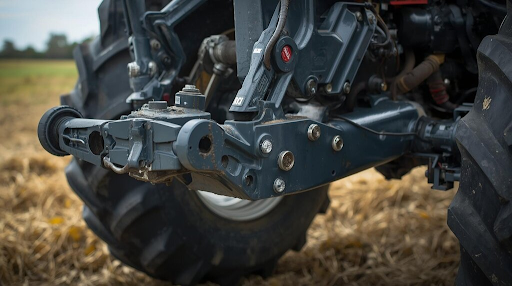
PTO stands for Power Take-Off, and you can think of your tractor’s PTO as a universal power outlet. It lets one engine (the tractor’s) run multiple tools — mowers, balers, sprayers, tillers, wood chippers, even water pumps.
The PTO is usually a splined rotating shaft at the back of the tractor that connects directly to attachments through a driveline. Once engaged, the tractor’s engine spins the shaft, powering the implement. This setup saves fuel, time, and equipment costs.
How Does the PTO Work?
When you engage the PTO lever or switch, it links the tractor’s engine to the rear PTO shaft using a clutch. As the shaft rotates, it transfers energy to an implement’s gearbox.
Once connected, every turn of the PTO shaft helps power your attachment’s moving parts — for example:
- Spinning the blades of a rotary mower
- Operating the auger of a grain elevator
- Turning the gears of a baler or sprayer pump
Basically, the PTO turns your tractor into a mobile power station for your entire farm.
Types of PTO Systems
Different tractors use different PTO designs. Understanding which one you have helps you operate and maintain it more effectively.
1. Transmission PTO
- Found on older or small tractors.
- The PTO stops when you press the main clutch (same as stopping the tractor).
- Simple but less convenient if you need to halt movement without stopping the implement.
2. Live PTO (Two-Stage Clutch)
- Uses a two-stage clutch pedal.
- Pressing halfway stops the wheels but keeps the PTO spinning.
- Pressing fully stops both PTO and wheels.
- Ideal for mowing or baling — you can pause your movement but keep your implement running.
3. Independent PTO
- The most modern and flexible option.
- Has its own separate clutch or button for control.
- You can turn it on or off anytime, even while driving.
- Provides smoother, more reliable operation.
Each type uses a mix of clutches, gears, and levers. If you notice stiffness, grinding noise, or difficulty engaging the PTO, it’s likely time for maintenance or replacement parts.
You can find quality replacement FridayParts tractor parts to keep your PTO smooth and reliable.
Knowing PTO Speeds and Shafts
To connect tractors and implements safely, PTOs follow standardized speeds and shaft designs.
540 RPM PTO:
- Most common on small and medium tractors.
- The shaft has 6 splines.
1000 RPM PTO:
- Found on larger, higher-horsepower machines.
- The shaft has 21 splines.
Running an implement at the wrong PTO speed can cause severe damage to the gearbox or driveline. Always check your manual or the label on the implement before connecting.
Worn or bent PTO shafts are also dangerous. If your shaft shows damage, replace it immediately. Replacement PTO shafts, yokes, and universal joints are available from FridayParts tractor parts to keep everything secure and safe.
PTO Safety Tips
A spinning PTO shaft can rotate over 9 times per second — fast enough to pull in loose clothing instantly. PTO safety is non‑negotiable.
Here’s how to stay safe:
- Always disengage PTO and turn off the engine before leaving the tractor or touching the implement.
- Keep all guards in place. Both the tractor’s master shield and the implement’s shaft cover are essential.
- Avoid loose clothing, jewelry, or untied shoelaces. Tie back long hair.
- Keep people and animals away when the PTO is engaged.
- Never step over or reach across a spinning PTO shaft. Always walk around the tractor.
A single lapse can cause serious injury — respect the PTO’s power at all times.
Quick Troubleshooting Guide
| Issue | Probable Cause | Quick Fix |
| PTO won’t engage | Faulty clutch or linkage | Check and adjust the clutch, inspect cables |
| PTO slips under load | Worn plates or low hydraulic pressure | Replace clutch plates or check fluid |
| Excess noise | Bearing wear or misalignment | Lubricate or replace bearings |
| Vibration in the shaft | Bent or unbalanced PTO shaft | Replace the damaged shaft |
PTO Maintenance Tips
- Grease U-joints regularly to prevent seizing.
- Inspect splines and guards before every use.
- Store PTO shafts indoors when not in use.
- Use the correct length PTO shaft. Misfit lengths cause binding or detachment.
Maintaining your PTO isn’t just about performance — it’s about safety and reliability every time you start your tractor.
Conclusion
The PTO is the heart of your tractor’s versatility. It allows one machine to perform dozens of jobs by transferring engine power to different implements.
By understanding how it works, what type of tractor you use, and how to maintain and operate it safely, you’ll avoid costly repairs and work efficiently in every season.